Mental Calculation Benefits
20 February 2020
- 2 min
Brain
Health
Improvement
Maths
The cognitive benefits of mental arithmetic
Mental arithmetic is a powerful exercise for the brain, offering a wide range of cognitive benefits that go far beyond fast arithmetic.
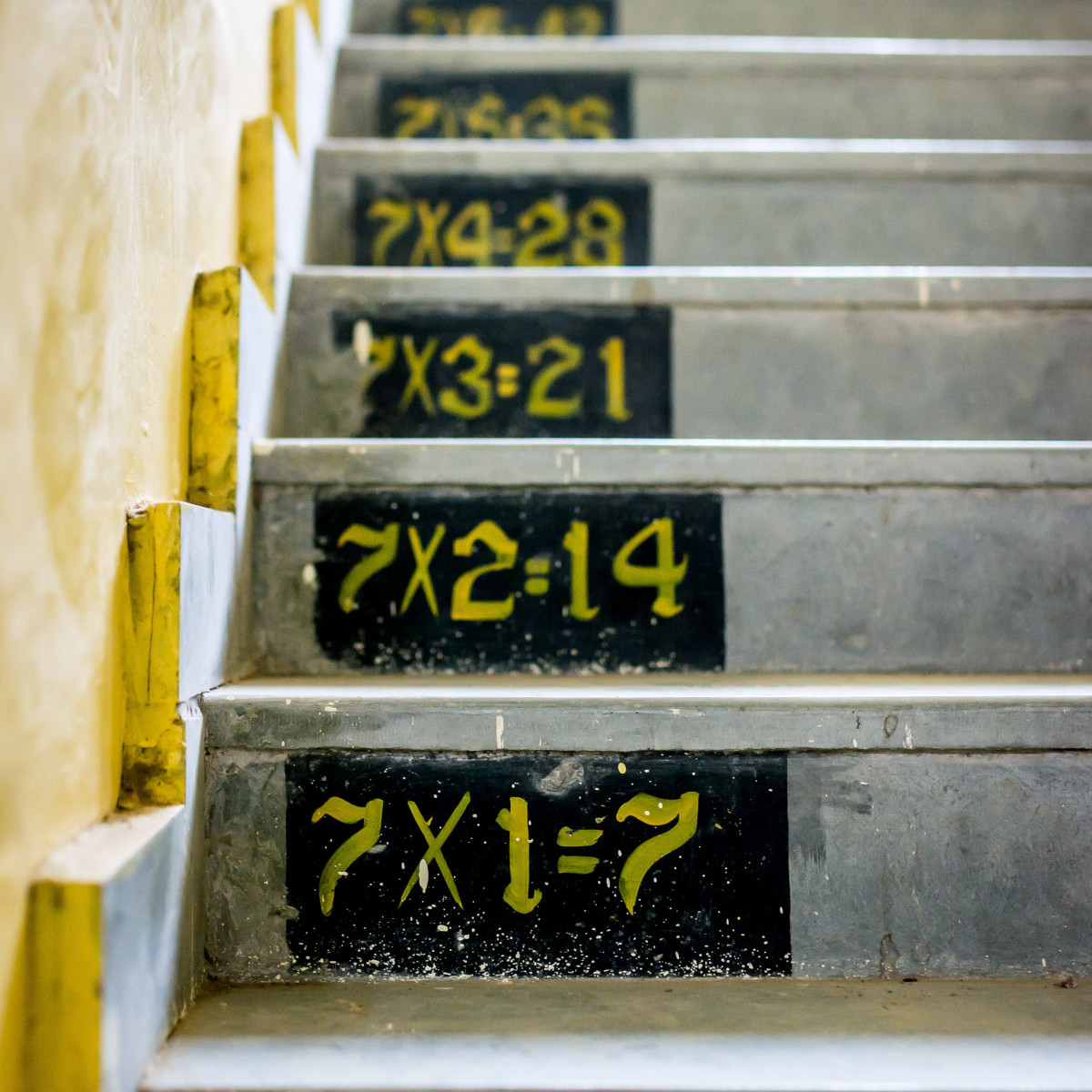 Classic mental training exercise to instantly recall mathematical facts and free up cognitive resources when solving complex problems. Picture by Gayatri Malhotra in unsplash.com.
1. Working memory training
Mental arithmetic is a demanding exercise for working memory. This is the brain’s notebook, where we temporarily store and manipulate information. When you calculate 78 x 9 in your head, you are not only remembering a piece of information, but you are also breaking the problem down into steps (e.g., 70 x 9 + 8 x 9, or 80 x 9 - 2 x 9), storing the intermediate totals, and combining them to get the final answer. This process strengthens the neural pathways in your working memory, making it more efficient not only for math, but also for following complex instructions, reasoning and learning.
2. Increase concentration and attention
Performing mental calculations regularly improves concentration and attention. Solving a problem mentally requires sustained attention, filtering out distractions to maintain the logical sequence. Studies using neuroimaging have shown that complex mental calculation activates a network of brain regions, including the prefrontal cortex, which is critical for maintaining attention and suppressing irrelevant information. This practice of deep concentration can be extended to other areas and activities.
3. Improves problem solving
Mental math also trains problem-solving skills. It encourages cognitive flexibility, which is the ability to approach a problem from different angles. For instance, you might solve 18 x 25 by thinking of it as (20 x 25) - (2 x 25), or as (18 x 100) / 4. This flexible thinking fosters creativity and the ability to devise multiple strategies for tackling challenges, both numerical and non-numerical.
References
- Human brain representations of internally generated outcomes of approximate calculation revealed by ultra-high-field brain imaging. Nat Commun 15, 572 (2024). Czajko, S., Vignaud, A. & Eger, E.
- Dissociating neural correlates of cognitive components in mental calculation. Cerebral cortex (New York, N.Y. : 1991), 11(4), 350–359. Gruber, O., Indefrey, P., Steinmetz, H., & Kleinschmidt, A. (2001).
- Arithmetic and the brain. Current opinion in neurobiology, 14(2), 218-224. Dehaene, S., Molko, N., Cohen, L., & Wilson, A. J. (2004).